
When most people hear the word stimming, they often think of autism or disability.
But the truth is, most people engage in some form of self-regulation every day.
Some people bounce their leg.
Some twirl their hair.
Some tap a pencil.
Some doodle while listening.
Some pace while thinking.
Some hum, sing, or fidget.
The reality is that self-regulation is a normal human experience.
The difference is often not whether someone stims.
The difference is how visible, frequent, intense, or noticeable that stim may be.
For some children living with visual impairments, stimming may serve additional purposes.
Because they receive less visual information from their environment than sighted children, some children naturally gather information and sensory input through movement and other experiences.
Rocking, spinning, turning, bouncing, and jumping can help support body awareness, balance, coordination, and spatial awareness.
Stimming may also help with:
- Emotional regulation
- Concentration
- Information processing
- Sensory exploration
- Comfort
- Self-awareness
A behavior that appears unusual to someone else may actually be serving an important purpose for the child.
It’s Usually Not About You
One of the most important things we can understand about stimming is that it is usually not directed at the people around us.
When a child is rocking, flapping, vocalizing, pacing, or engaging in another repetitive behavior, they are typically responding to their own needs.
They are not usually trying to annoy anyone.
They are not trying to be disrespectful.
They are not trying to make others uncomfortable.
The behavior is often serving the needs of the person doing it.
Not sending a message to everyone else.
Understanding this can help us respond with empathy instead of frustration.
Two Things Can Be True
I think it’s important to acknowledge something that is often left out of these conversations.
A child may need a particular form of self-regulation.
And another person may genuinely find that behavior distracting.
Both experiences can be valid.
Understanding someone else’s needs does not require ignoring your own.
Coexistence means making room for both.
I’ve experienced this in my own family.
My youngest daughter sometimes tells me that certain stimming behaviors bother her.
She’s not trying to be unkind.
She’s being honest.
Those moments create opportunities for important conversations.
We’ve talked about the fact that her sister isn’t engaging in these behaviors to upset her.
She’s meeting a need.
We’ve also talked about the fact that it’s okay to feel distracted sometimes.
The goal isn’t to pretend those feelings don’t exist.
The goal is learning what to do with them.
What Can You Do If Someone’s Stimming Bothers You?
If someone’s stimming is bothering you, consider a few options.
1. Ignore It and Refocus
Sometimes simply redirecting your attention is enough.
Not every behavior requires a response.
2. Remember It Isn’t Personal
The behavior is usually not about you.
Understanding that can help reduce frustration.
3. Move to Another Area
When possible, creating a little distance can help.
This isn’t rejection.
It’s simply another way of meeting your own needs.
4. Practice Empathy
You don’t have to fully understand someone’s experience to treat them with kindness and respect.
Curiosity often leads to understanding.
Understanding often leads to compassion.
Children Living with Visual Impairments Deserve Social Awareness Too
This conversation should never be about shame.
And it should never be about teaching a child that something is wrong with them.
However, I do believe children deserve opportunities to learn social awareness.
Different environments sometimes have different expectations.
A loud vocal stim that works well on a playground may be distracting in a classroom, library, movie theater, or on public transportation.
That doesn’t mean the child’s needs stop mattering.
It simply means we can help children build a larger toolbox.
Some children may choose a quieter stim.
Others may take movement breaks.
Others may use fidgets.
Others may use art, music, or another form of sensory input.
The goal is not to eliminate self-regulation.
The goal is to expand options.
Self-advocacy includes understanding your own needs.
It also includes learning how to navigate shared spaces while respecting the needs of others.
Expanding the Toolbox
I’ve seen this firsthand with my own daughter.
She loves creating rubber band art, bracelets, and keychains.
What started as a creative hobby became much more than that.
Her creations often include dangling rubber bands, charms, beads, and pieces she can move, shake, and interact with.
The activity wasn’t designed to stop stimming.
But it became another tool in her toolbox.
This is why I often encourage families to focus less on eliminating harmless behaviors and more on helping children discover hobbies, interests, and activities that bring them joy.
Sometimes confidence grows through creativity.
Sometimes self-regulation grows through creativity.
And sometimes a hobby becomes much more than a hobby.
Building a More Understanding World
I believe one of the most important lessons we can teach children is that different does not automatically mean dangerous, disrespectful, or wrong.
We don’t all regulate ourselves in the same way.
We don’t all move through the world in the same way.
And that’s okay.
The goal isn’t to make everyone the same.
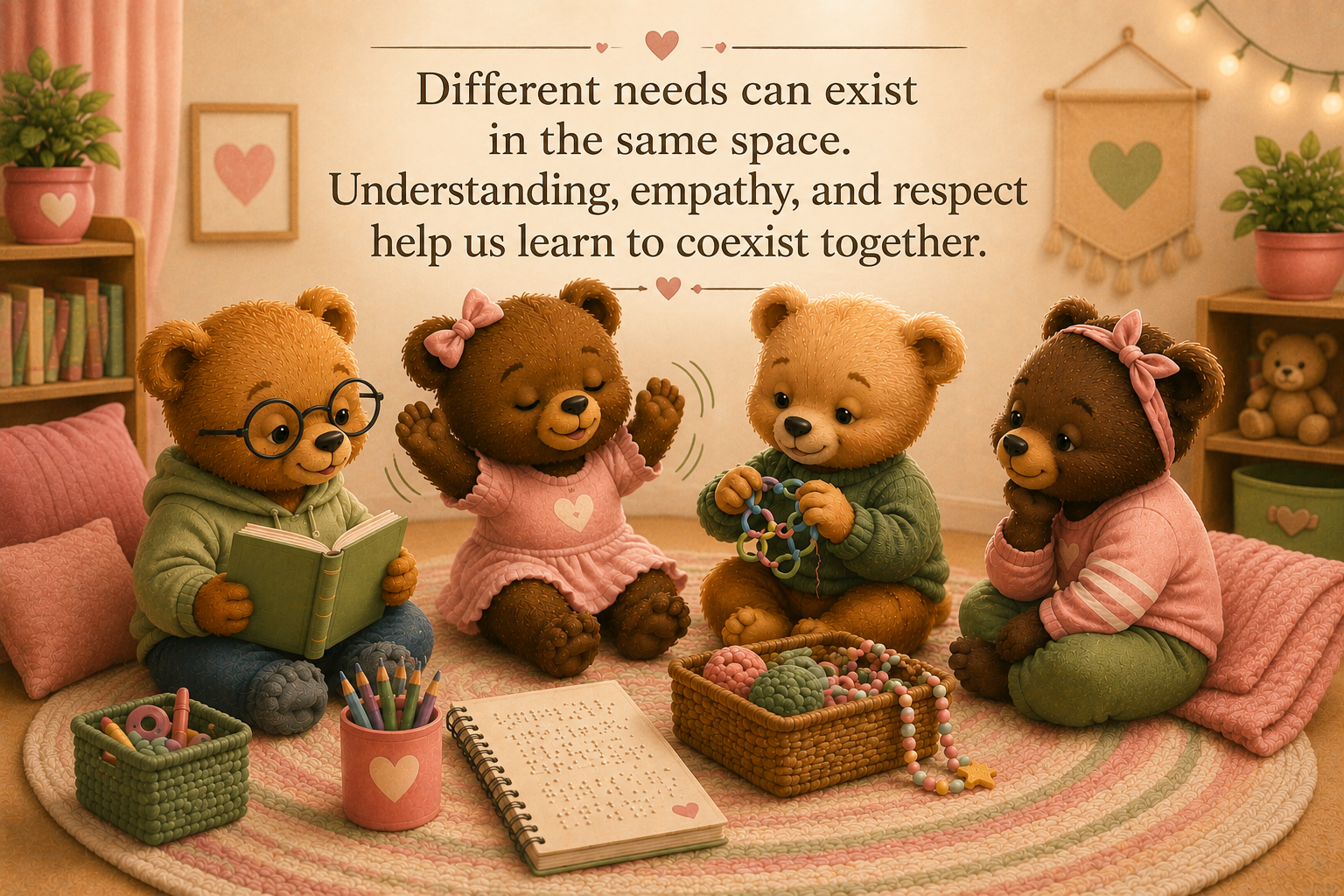
The goal is to create spaces where different needs can exist together respectfully.
At Cub Club by Imani, we’re focused on building Brickhouse Confidence.
Confidence built through understanding.
Confidence built through communication.
Confidence built through self-awareness.
And confidence built through self-advocacy.
Because the goal isn’t to raise children who look confident.
The goal is to raise children who are confident.
Not everything I share will fit every cub.
There is no one-size-fits-all approach to raising a child living with a visual impairment.
Every cub is different.
Every family is different.
Every journey is different.
And perhaps most importantly:
Raising a child living with a visual impairment is not hard.
It’s just different.
– Ima♥︎i
Cub Club by Imani
Building Confident Self-Advocates 🧸🧱✨